Quick answer
An LED wall is usually the strongest choice when brightness, visibility and continuous operation are priorities. Projection mapping works best when architecture, unusual surfaces or visual transformation are central to the idea. Interactive displays are more suitable when visitors need to explore information, make choices or actively participate.
But there is no universally “best” event technology. The right choice depends on the venue, audience, content, viewing distance, installation conditions and the experience the brand wants to create.
This guide compares LED walls, projection mapping and interactive displays to help event teams make that decision with greater clarity.
LED wall vs projection mapping vs interactive displays: a quick comparison
| Consideration | LED wall | Projection mapping | Interactive display |
|---|---|---|---|
| Best suited for | High-impact visuals and large audiences | Transforming surfaces and environments | Guided participation and information |
| Ambient light performance | Generally strong | Depends heavily on projector output and environment | Strong at close viewing distances |
| Surface requirements | Modular display structure | Suitable projection surface and clear throw path | Screen, mounting and accessible interaction area |
| Content format | Motion graphics, films, presentations and live feeds | Surface-mapped animation created to exact geometry | Interactive application or touch-based interface |
| Audience behaviour | Primarily viewing | Primarily viewing, with optional interaction | Active participation |
| Installation priority | Structure, power, processing and pixel pitch | Projector positioning, brightness, alignment and calibration | Accessibility, software stability and user flow |
| Typical strength | Visibility and visual scale | Creative freedom across unusual forms | Engagement and information discovery |
The table provides a starting point. The final decision should be based on the actual event environment rather than the technology name alone.
When should you choose an LED wall?
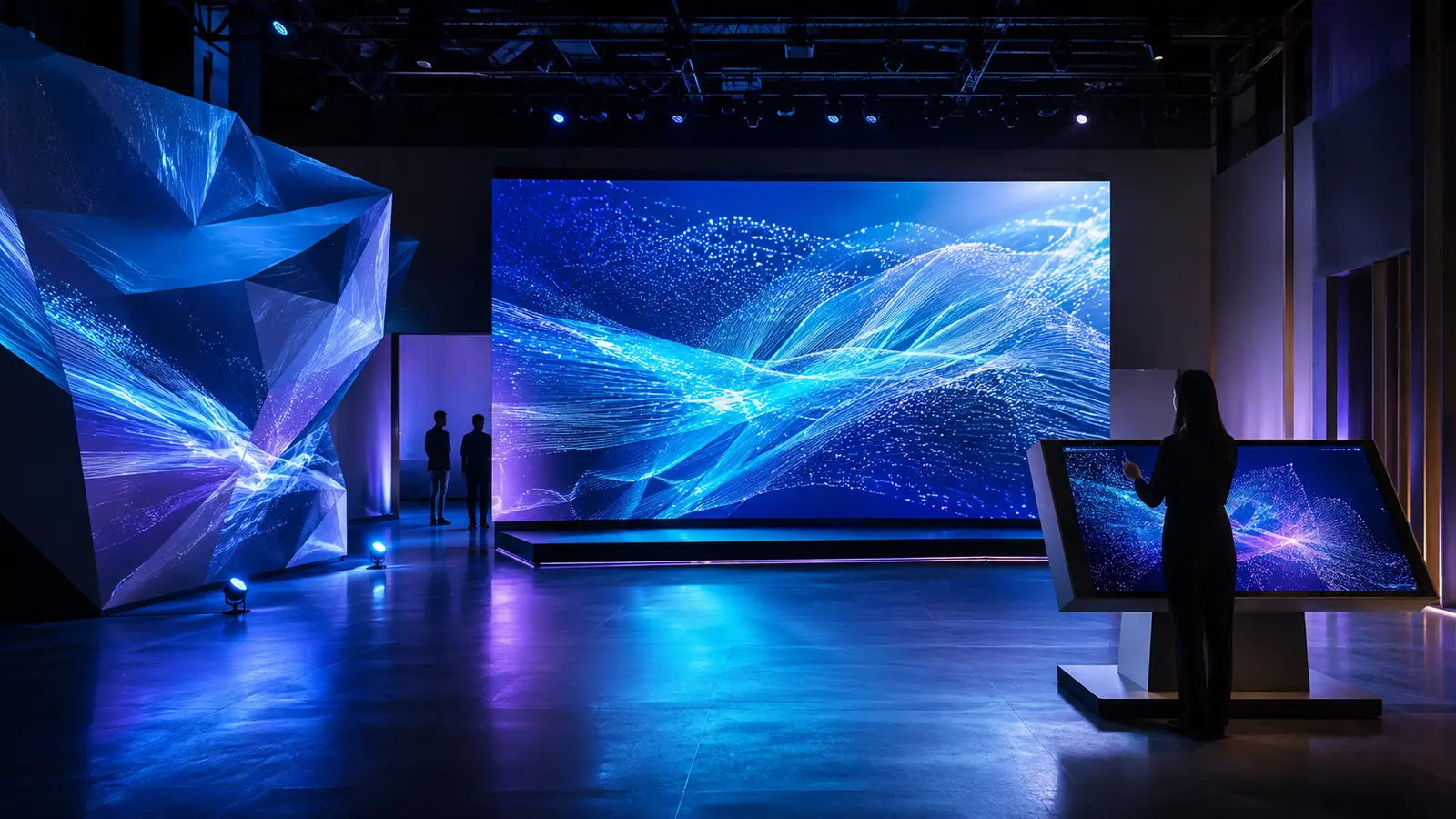
An LED wall creates its image directly through individual light-emitting pixels. It does not depend on light being projected onto another surface, making it well suited to exhibition halls, conferences, brand launches and environments where ambient lighting cannot be fully controlled.
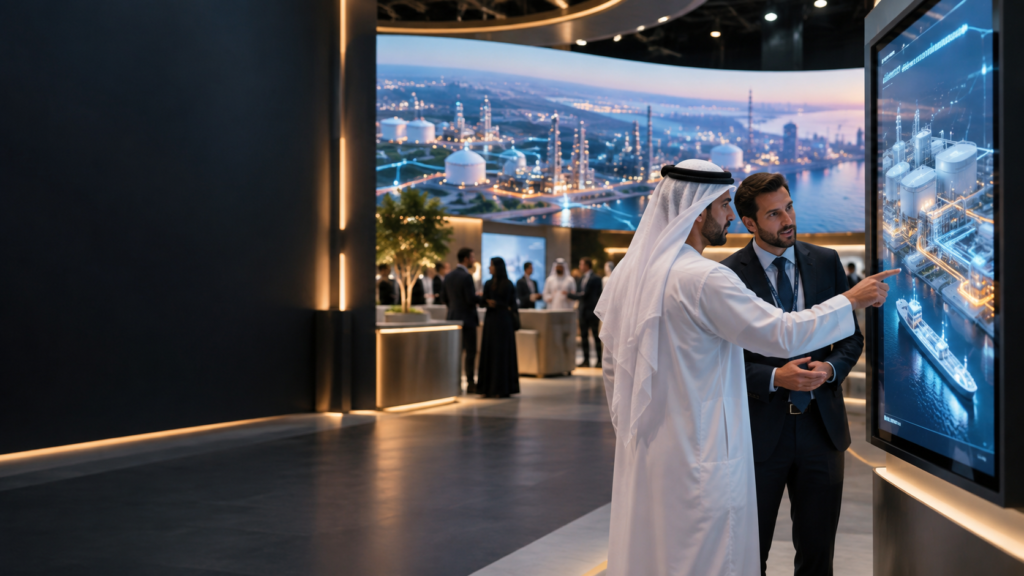
For a busy Dubai exhibition or corporate event, an LED wall can provide a strong visual anchor that remains visible from a distance.
It is particularly effective for:
- Large presentation backdrops
- Exhibition stand feature walls
- Product launches
- Live camera feeds
- Branded motion graphics
- Conference stages
- Digital scenic environments
- High-traffic public activations
LED is also modular. Cabinets can be assembled into different dimensions and, with the appropriate system, can form curves, columns, corners or other architectural configurations.
Brightness and visibility
One of the main advantages of an LED wall is its ability to maintain visual impact in bright environments. This is important in exhibition halls where overhead lighting, neighbouring stands and daylight can reduce the contrast of other display technologies.
However, maximum brightness is not always the objective. Excessive output at a short viewing distance can feel uncomfortable and may affect how accurately content appears. The LED processor and display should be calibrated according to the venue rather than operated at maximum brightness by default.
Pixel pitch and viewing distance
Pixel pitch describes the distance between the pixels of an LED display. A smaller pixel pitch generally provides a finer image at close viewing distances, while larger-pitch products may be appropriate when audiences remain farther away.
The correct specification depends on:
- Closest expected viewer
- Overall screen dimensions
- Content resolution
- Camera use
- Budget
- Installation environment
Choosing a specification simply because it has the smallest available pixel pitch can increase cost without creating a meaningful visual improvement.
Limitations of LED walls
An LED wall requires structure, processing, power distribution and professional installation. The physical depth and weight must be considered during stand or stage design.
The content also needs to be produced for the final canvas. Stretching a conventional presentation across an unusually wide LED wall can lead to awkward compositions, empty areas or unreadable text.
Choose LED when visibility and scale matter—but confirm the screen dimensions and resolution before producing the content.
When should you choose projection mapping?
Projection mapping uses one or more projectors to place visual content onto a physical surface. Instead of treating the surface as a conventional rectangular screen, the content is aligned with its architectural shape.
This makes projection mapping particularly effective when the surface itself is part of the story.
It can be used on:
- Building façades
- Sculptures
- Stage scenery
- Exhibition structures
- Vehicles
- Product replicas
- Interior walls
- Curved or irregular surfaces
A static object can appear to move, open, transform or respond to its surroundings without physically changing.
Creative flexibility
Projection mapping gives designers the freedom to integrate digital content with physical architecture. It can create an environment that feels more theatrical and spatial than a conventional screen installation.
The technique works best when the content is developed around an accurate model or measurement of the projection surface. Each visual element must align with the intended geometry.
This means projection mapping is not simply a projector playing a video. It is a coordinated system involving surface design, content creation, lens selection, projector positioning, media playback and calibration.
Ambient light and projection conditions
Projection competes with the light already present in the environment. A dark or controlled venue will usually produce stronger contrast than a brightly illuminated exhibition floor.
Modern high-output projectors can support demanding event applications, but the projection surface, image size, throw distance and ambient lighting still need to be evaluated together. Larger images require the available light output to cover a greater area.
The technical review should consider:
- Projector brightness
- Surface colour and reflectivity
- Throw distance
- Lens selection
- Mounting location
- Shadows and physical obstructions
- Ambient lighting
- Number of projectors
- Edge blending
- Content resolution
Limitations of projection mapping
A clear projection path must be maintained. People, scenic elements or suspended equipment can create shadows if they enter that path.
The installation may also require more calibration time than a conventional display. If a projector or physical surface moves after alignment, the content may need to be recalibrated.
Choose projection mapping when transformation and spatial storytelling are more important than simply displaying a bright rectangular image.
When should you choose an interactive display?
An interactive display changes the visitor from a viewer into a participant.
It may use touch, gesture, sensors, physical objects, cameras or other inputs, but the purpose is the same: allow the audience to influence what happens on the screen.
Interactive displays are useful for:
- Product exploration
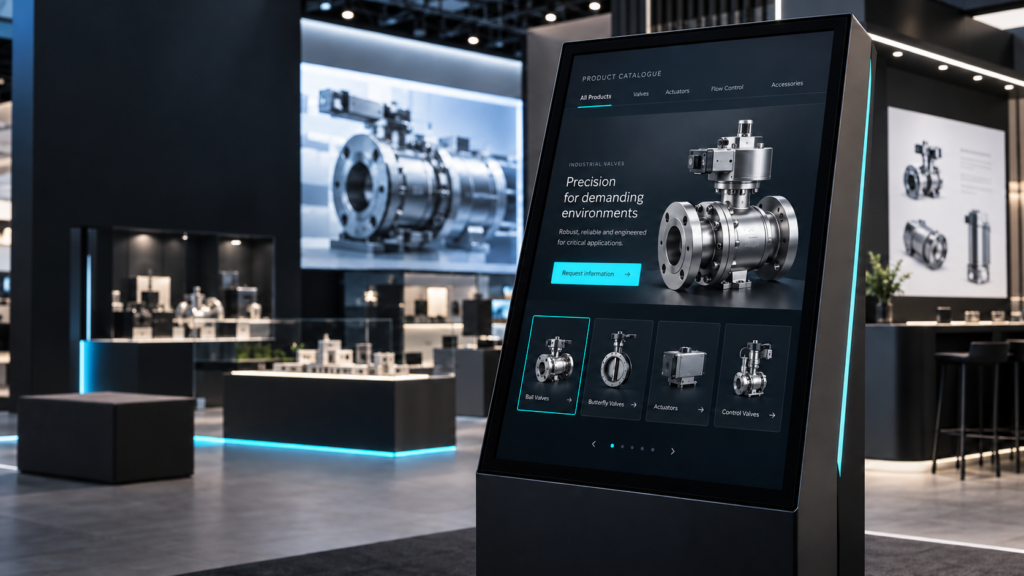
- Digital catalogues
- Wayfinding
- Configuration tools
- Quizzes and games
- Data visualisation
- Lead-generation journeys
- Educational content
- Personalised recommendations
- Museum and showroom experiences
They work particularly well when the visitor needs to navigate detailed information that would be difficult to communicate through a continuously playing video.
Interaction must be immediately understandable
Visitors at events rarely receive detailed instructions. The interface should make the next action obvious within a few seconds.
Buttons should be large enough to use comfortably. Text should remain readable at the expected distance. The system should provide clear feedback after every touch or gesture, and it should automatically return to its starting screen when the interaction ends.
Before development, define:
- What the visitor will do
- How long the interaction should take
- How many people can participate
- Whether assistance is required
- What happens at the end
- Whether any information will be collected
- How the application resets
- What happens if connectivity is unavailable
The screen is only one component. The interface, application and visitor journey determine whether the interaction feels useful.
Limitations of interactive displays
Interactive experiences require software testing as well as hardware testing. Buttons, animations, media and data capture must remain responsive throughout the event.
A highly detailed application can also create queues if each visitor needs several minutes to complete it. In high-traffic environments, a shorter experience or multiple interaction points may produce better participation.
Choose an interactive display when active exploration supports the event objective—not simply because touch technology is available.
How should the venue influence the decision?
The venue can eliminate or favour certain options before creative production begins.
For an exhibition stand with strong ambient light and visitors approaching from multiple directions, an LED wall may provide the most dependable visibility.
For a controlled launch environment with a custom-built scenic structure, projection mapping may create a more integrated transformation.
For a product range containing extensive specifications or selectable options, an interactive display may allow each visitor to explore the information most relevant to them.
Before confirming the technology, review:
- Venue lighting
- Available installation space
- Rigging and structural restrictions
- Power distribution
- Network availability
- Sound restrictions
- Visitor circulation
- Viewing distance
- Installation schedule
- Technical access during operation
The same concept can perform very differently in two venues. Site conditions should influence the format from the beginning.
How do content requirements differ?
Each technology requires content to be produced differently.
Content for LED walls
LED content should match the final canvas resolution and aspect ratio. Important text and brand elements must remain visible from the intended viewing distance.
Ultra-wide, curved or unusually shaped LED displays need custom content layouts. Conventional 16:9 videos may not use the complete canvas effectively.
Content for projection mapping
Projection-mapping content must correspond with the geometry of the physical surface. The content team may require technical drawings, measurements, photographs or a three-dimensional model.
Allow time for on-site alignment and content adjustment after the projection system is installed.
Content for interactive displays
Interactive content requires interface design, development, testing and user-state planning. The team must create not only the main visual screens but also loading states, instructions, feedback, error handling and reset behaviour.
Content and hardware should therefore be planned as a single system. This is also one of the central principles in our immersive-technology planning guide.
Which option is more cost-effective?
Cost cannot be determined from the technology category alone.
An LED wall may involve display cabinets, processors, structure, power distribution, installation and content adaptation. Projection mapping may require several high-output projectors, specialised lenses, media servers, rigging, calibration and custom animation. An interactive display may appear physically simpler but require extensive software and content development.
A useful comparison should include the complete delivery scope:
- Equipment
- Content production
- Structural requirements
- Installation labour
- Programming
- Testing
- Transportation
- On-site support
- Backup systems
- Dismantling
The lowest equipment quotation is not necessarily the lowest project cost. It may exclude the content, technical infrastructure or operational support required to make the experience work.
Can LED, projection and interaction be combined?
Yes. Many effective experiences use more than one display technology, but each element should have a defined purpose.
For example:
- An LED wall can attract visitors from a distance.
- An interactive display can allow closer product exploration.
- Projection can extend the visual environment onto surrounding physical surfaces.
- Sensors can connect visitor actions with large-format content.
- A touchscreen can control visuals shown on a larger LED canvas.
Combining technology should create a more coherent visitor journey—not merely increase the equipment list.
Every additional system introduces more content states, signal paths and operational dependencies. Integration and testing become increasingly important as the experience becomes more complex.
A practical selection checklist
Before choosing between an LED wall, projection mapping and an interactive display, answer these questions:
- What should the visitor notice, understand or do?
- How far away will the audience be?
- How much ambient light is present?
- Is the physical surface important to the creative idea?
- Does the visitor need to control or explore the content?
- How many people should experience it simultaneously?
- What installation time is available?
- What power, data and structural support are available?
- Does the content already exist, or must it be produced?
- Who will operate and support the experience during the event?
- What backup or recovery process is required?
- How will success be measured?
If the answers remain unclear, technology selection is premature.
Selecting event technology with purpose
An LED wall is not automatically more impressive than projection mapping. Projection mapping is not automatically more immersive than an interactive display. Interaction is not automatically engaging simply because a visitor can touch the screen.
The value comes from selecting and integrating the technology around a clear objective.
At Stedder Technology, we help agencies and brands connect the creative concept with the practical systems required to deliver it—from professional AV and large-format displays to interactive applications, content integration, installation and technical operation.
Explore our selected projects or review our professional AV solutions to understand how different technologies can support different environments.
Planning an exhibition, brand activation or corporate event in Dubai or elsewhere in the UAE? Discuss your project with Stedder Technology.