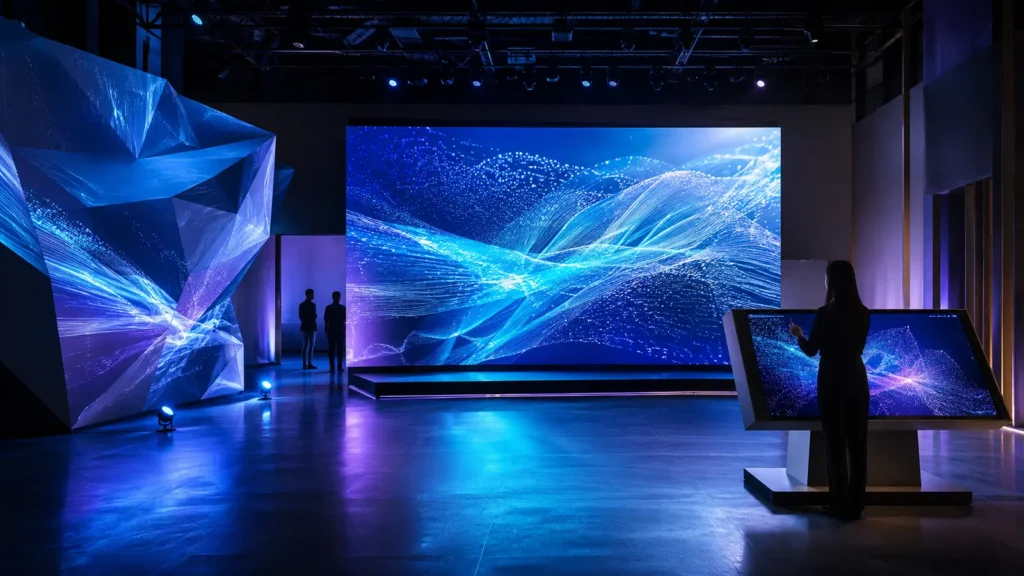
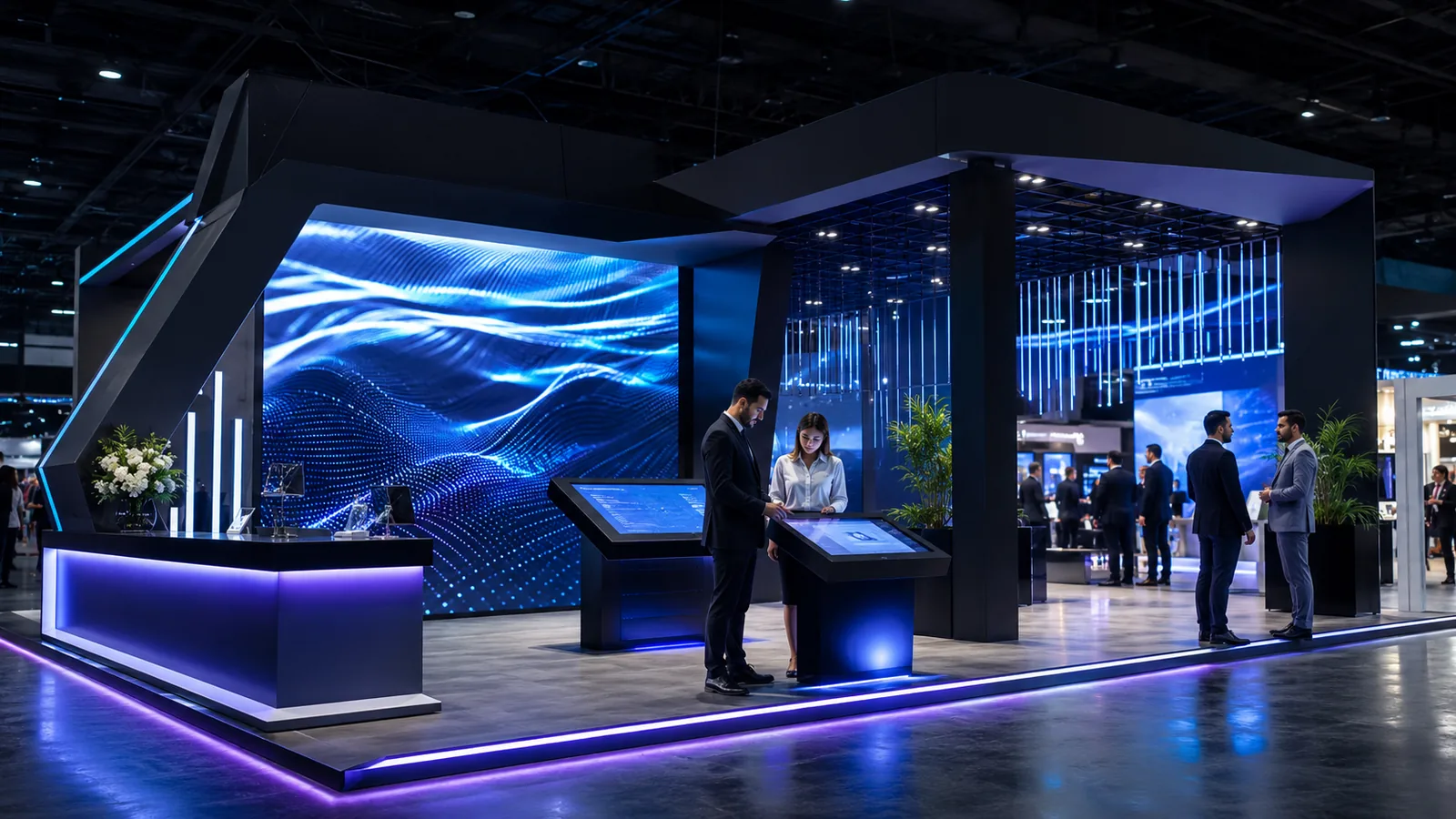
Interactive exhibition stand Dubai projects often begin with the same request: “We want something engaging.” But engagement does not come from placing a touchscreen, LED wall or virtual reality headset inside a booth. It comes from designing a clear experience that gives visitors a reason to stop, participate and continue a conversation with the brand.
Dubai exhibitions are highly competitive environments. Visitors move quickly, neighbouring stands compete for attention and sales teams have only a short window to create a meaningful connection. A successful interactive stand therefore needs to combine creative thinking, technology, content and reliable technical delivery around one clear business objective.
This guide explains how brands and agencies can design an interactive exhibition experience that attracts attention and supports genuine lead generation.
1. Define the action you want visitors to take
Before selecting any technology, decide what the visitor should do.
Should they explore a product range? Compare technical information? Experience a future environment? Create personalised content? Enter a competition? Request a demonstration? Or speak with a representative?
“Make the stand interactive” is not a complete brief. The interaction needs a defined purpose and a logical next step.
For example, an interactive product wall can help visitors browse a large catalogue without displaying every physical item. A virtual reality experience can place them inside an environment that cannot be recreated on the exhibition floor. A digital mosaic can turn visitor photographs into a growing branded installation.
The correct format depends on the outcome—not simply on which technology looks most impressive.
2. Design the complete visitor journey
An effective exhibition experience should be planned as a journey with four stages:
Attraction
Something visible from the aisle creates curiosity. This could be movement, scale, responsive content, an unusual display format or a clear invitation to participate.
Understanding
Within a few seconds, visitors should understand what the experience is and how to begin. Confusing instructions reduce participation, regardless of how advanced the technology may be.
Interaction
The activity should reward the visitor with something useful, memorable or enjoyable. Interaction may include touch, movement, gesture, physical objects, personalised content or a shared group experience.
Conversion
The experience should lead naturally towards a business action: speaking with the team, requesting information, scanning a QR code, booking a demonstration or sharing contact details.
If the journey ends immediately after the visual effect, the technology may generate attention without producing meaningful leads.
3. Choose technology according to the objective
Different interactive technologies solve different communication problems.
Not sure which format fits your environment? Compare LED walls, projection mapping and interactive displays before selecting the technology.
Interactive touch displays
Touchscreens work well when visitors need to explore detailed information at their own pace. They can support product catalogues, configurators, maps, surveys, presentations and lead-capture applications.
The interface should use large buttons, short text and clear navigation. Exhibition visitors are unlikely to spend time learning a complicated system.
Interactive LED walls and floors
Sensor-driven LED surfaces can respond to movement, touch or visitor position. They are effective for attracting attention, supporting group participation and transforming a large physical area into a responsive canvas.
They require careful coordination between the LED system, sensors, media server, content and physical installation.
Projection mapping
Projection mapping can transform architectural surfaces, products and scenic structures without relying on a conventional rectangular screen. It works particularly well when the physical form of the stand is part of the story.
Brightness, throw distance, ambient light and projector positioning must be studied before the content is produced.
Virtual and augmented reality
VR is valuable when the audience needs to enter a location, product or scenario that cannot be presented physically. AR can add digital information to products, printed material or real spaces without fully isolating the visitor from the exhibition environment.
Both formats need clear onboarding, hygiene planning, trained operators and an appropriate throughput strategy.
Gesture and motion interaction
Camera or sensor-based systems allow visitors to control content through body movement. These experiences can feel intuitive and attract attention because the interaction is visible to other people nearby.
The sensing area, lighting conditions, visitor distance and background movement must be tested carefully.
The strongest immersive technology solutions are selected around the audience and message rather than added as decoration.
4. Keep the interaction fast and intuitive
Exhibition visitors do not behave like users sitting comfortably at home. They may be carrying bags, speaking with colleagues, checking schedules or moving between meetings.
The experience should therefore communicate three things immediately:
- What am I expected to do?
- How long will it take?
- What will I receive or discover?
Most interactions should begin without a long registration process. If information must be collected, ask only for what the sales team genuinely needs.
Use visual instructions instead of large paragraphs. Provide an obvious starting point and a clear way to restart the experience for the next visitor.
A member of the booth team should also be able to explain the activity in one sentence.
5. Build lead capture into the experience
Lead generation should feel like a natural part of the visitor journey rather than a form placed at the end.
One approach is to provide a personalised result. After using a configurator, quiz or product selector, visitors can receive their recommendation by email or QR code. Another option is to connect participation with a demonstration, consultation or relevant downloadable resource.
The data requested should match the value being offered. Asking for excessive information can reduce participation and create low-quality entries.
It is also important to plan how captured leads will reach the sales team. Define the required fields, consent language, data-export format and follow-up process before the exhibition opens.
Technology can collect information, but the commercial value comes from timely and relevant follow-up.
6. Connect digital content with the physical stand
The screen or sensor should not feel like an unrelated device placed inside an otherwise finished booth.
Technology works best when the stand architecture, lighting, graphics, visitor flow and digital content are planned together.
A touchscreen should sit at a comfortable height with enough space for people to gather. A projection surface should be designed around the projector position and lighting conditions. A motion-controlled experience needs a clearly defined participation zone. An LED installation needs appropriate structural support, power distribution, cooling and service access.
The digital design should also follow the visual language of the physical environment. Colours, typography, animation and transitions should feel like part of one brand experience.
This coordination is why immersive content production should begin alongside technical and spatial planning—not after the equipment has already been confirmed.
7. Plan for visitor throughput
A visually impressive experience can still fail if only a few people can use it during a busy exhibition day.
Estimate:
- How long one interaction takes
- How many visitors can participate simultaneously
- Whether people need assistance
- Where the queue will form
- How the experience resets
- What waiting visitors can see or do
If a headset experience takes five minutes and serves one person at a time, it may require multiple stations or a secondary screen showing what the participant is seeing.
Group experiences can often achieve higher visibility and throughput. Individual experiences may deliver greater depth but require more operational control.
The right balance depends on the expected footfall, available space and importance of each lead.
8. Prepare for real exhibition conditions in Dubai
An exhibition stand is a temporary production environment with fixed access schedules and limited time for installation, testing and approval.
Technology planning should account for:
- Venue power requirements
- Internet availability and backup connectivity
- Rigging and structural restrictions
- Equipment access and ventilation
- Ambient light and sound
- Content playback specifications
- Installation and dismantling schedules
- Spare cables, devices and critical components
- On-site technical support
Content should be available locally whenever possible. A live internet connection should not be the only method for running a central experience.
Critical systems also need a recovery plan. The team should know how to restart the experience, switch to backup content or replace a device without disrupting the full stand.
Professional AV rentals, software, content and technical operations must function as one system throughout the exhibition.
9. Test the experience as a visitor would use it
Technical testing should go beyond confirming that the screen turns on and the application launches.
Test the complete journey:
- Approach the stand from the aisle.
- Identify the invitation to interact.
- Begin without receiving additional instructions.
- Complete the activity.
- Receive the result or next step.
- Confirm that any captured data reaches the correct destination.
- Reset the system for the next visitor.
Test with people who were not involved in creating the project. They are more likely to identify unclear instructions, slow transitions or confusing interface decisions.
The final test should happen in the actual exhibition environment because lighting, noise, network conditions and surrounding movement can affect the experience.
10. Give the booth team a clear operating role
Interactive technology does not replace human conversation. Its job is to make the first interaction easier, more relevant and more memorable.
Brief the booth team on:
- How to introduce the experience
- When to assist and when to step back
- What questions to ask afterwards
- How leads are recorded
- Who handles technical issues
- How the system is opened and closed each day
A well-trained host can connect the visitor’s interaction with the appropriate product, specialist or commercial conversation.
Without this connection, the technology may remain an attraction rather than becoming a sales tool.
11. Measure outcomes beyond footfall
A crowded booth may look successful, but footfall alone does not show whether the experience supported the business objective.
Useful measures can include:
- Number of completed interactions
- Average interaction time
- Qualified leads captured
- Demonstrations requested
- Meetings booked
- Content downloads
- QR-code scans
- Most explored products or topics
- Follow-up response rate
Define these measures before development begins so that the experience can collect the right information.
The goal is not simply to prove that people interacted. It is to understand whether the interaction moved them closer to a meaningful relationship with the brand.
Common mistakes to avoid
Several problems repeatedly reduce the impact of interactive exhibition stands:
- Selecting equipment before defining the objective
- Creating a complicated or time-consuming interaction
- Treating digital content as an afterthought
- Ignoring queue position and visitor flow
- Relying completely on venue internet
- Collecting information without a follow-up plan
- Using technology that the booth team cannot operate
- Leaving insufficient time for integration and testing
- Measuring attention without measuring business outcomes
Avoiding these problems usually creates more value than adding another layer of technology.
Technology should support the conversation
A successful interactive exhibition stand in Dubai does not need to use every available technology. It needs one clear idea, an intuitive visitor journey and a reliable connection between participation and business conversation.
Start with the audience. Define the action. Select the appropriate format. Build content and technology together. Test under real conditions. Then prepare the booth team to turn interaction into opportunity.
Stedder Technology designs and delivers interactive exhibition experiences, immersive content and integrated technical systems for brands and agencies across the UAE.
Explore our work to see how technology can transform physical environments, or discuss your next exhibition experience with our team.