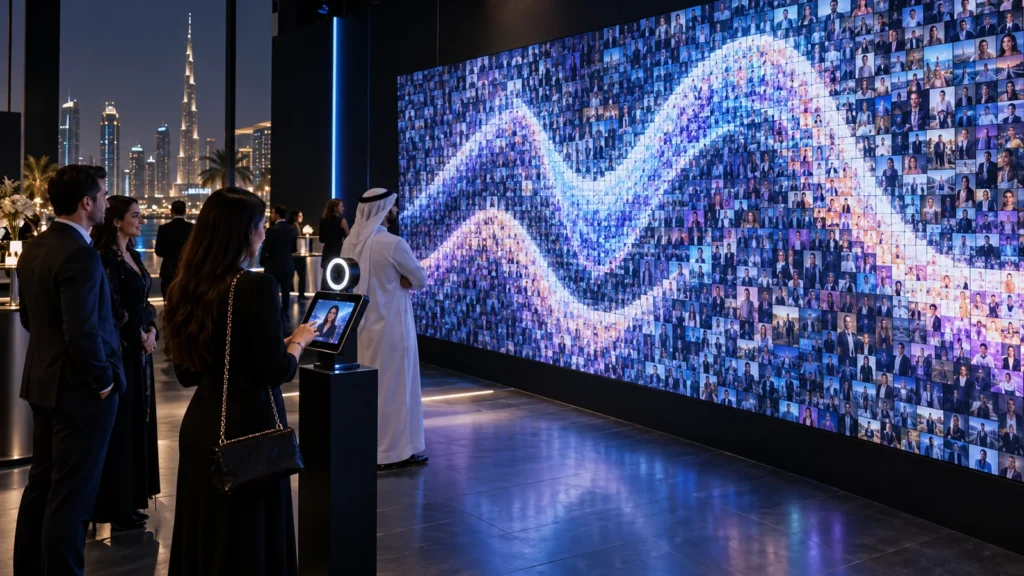
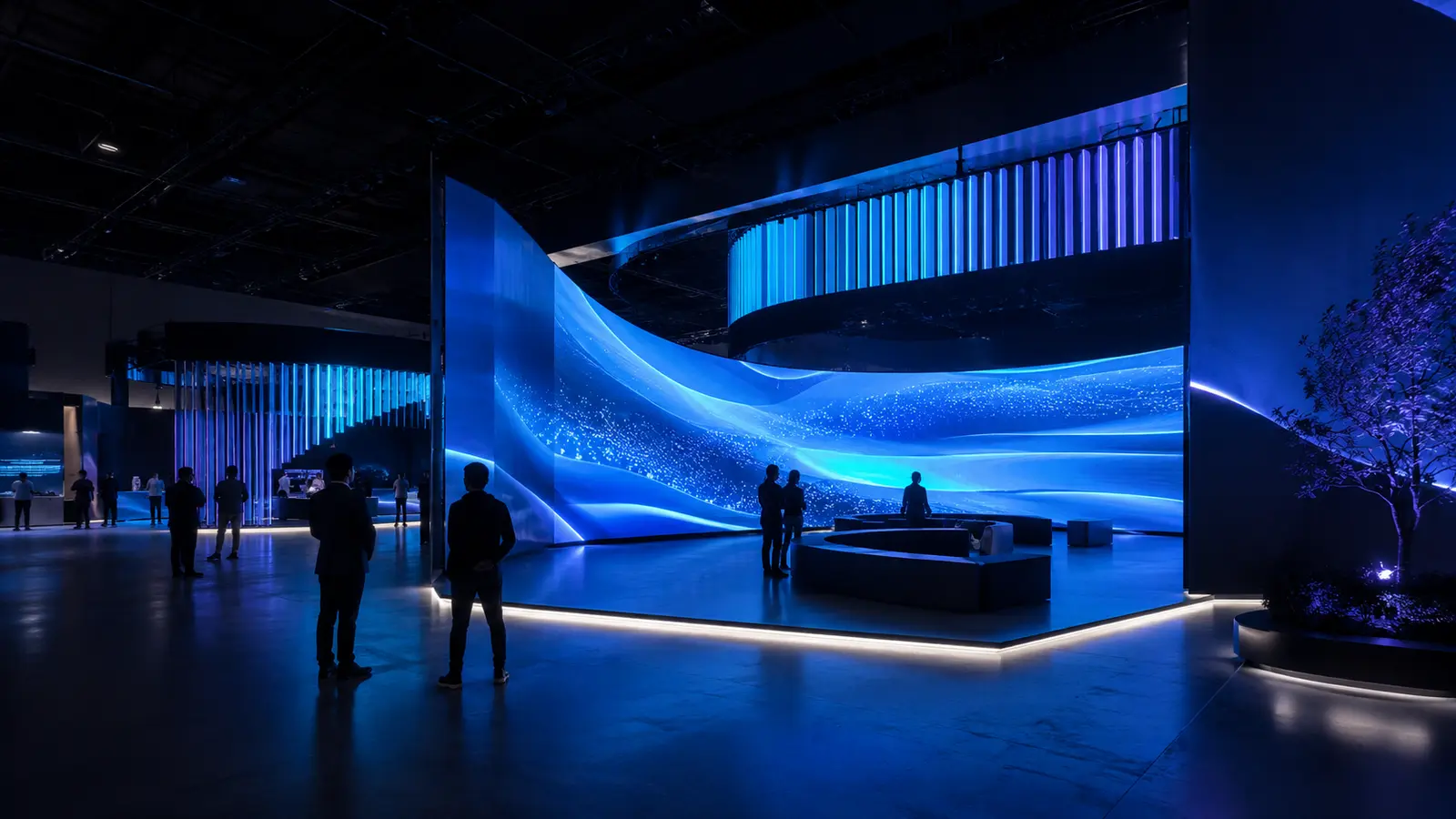
Immersive technology can turn an ordinary event space into something people want to explore, photograph and remember. But the most successful experiences are rarely created by adding a large screen, an interactive sensor or a virtual reality headset at the last minute.
They begin with a clear understanding of the audience, the environment and the action the experience should inspire.
For brands, event agencies and exhibition teams working in Dubai, this planning stage is particularly important. Venues move quickly, installation windows can be tight, and every technical element must work within a larger production involving design, fabrication, content, power, networking and on-site operations.
Before selecting the technology, make these seven decisions.
1. Define what the audience should experience
“Make it immersive” is an ambition, not yet a brief.
Start by defining what a visitor should feel, understand or do. Should the experience attract people from across an exhibition hall? Explain a complex product? Encourage participation? Generate content for social media? Collect qualified leads? Or create a memorable moment around a brand launch?
The objective determines the format.
A large-scale visual installation may be effective for visibility, while an interactive wall can support exploration. Virtual reality may be valuable when the audience needs to enter an environment that cannot physically be recreated. A touchscreen experience can work better when visitors need to compare information or move through detailed content at their own pace.
The strongest technology choice is the one that makes the intended audience action feel natural.
2. Understand the space before designing the experience
Immersive experiences do not exist independently of their surroundings. Viewing distance, ceiling height, ambient light, visitor movement and sound levels all affect how the installation performs.
An LED display that looks dramatic in a controlled presentation may lose impact in a brightly illuminated exhibition hall. A motion-tracking installation needs enough unobstructed space for visitors to interact comfortably. Directional audio may be required when multiple activations operate close together.
A proper site or technical review should consider:
- Available dimensions and structural restrictions
- Audience entry and exit points
- Expected viewing distance
- Ambient lighting and reflections
- Power and data availability
- Rigging and load limitations
- Sound restrictions
- Installation and dismantling access
- Emergency routes and venue regulations
Designing around the real environment prevents expensive compromises during production.
3. Choose the interaction before choosing the hardware
Technology discussions often begin with equipment: LED, projection, touchscreens, sensors, VR or transparent displays. A better approach is to define the interaction first.
Ask what the audience will physically do.
Will they touch, move, gesture, speak, scan, compete, create or simply observe? How many people should participate at once? How long should each interaction last? Does someone need to guide the visitor, or should the experience be immediately understandable?
For a busy exhibition stand, an interaction lasting 30 to 60 seconds may keep visitors moving while still creating meaningful engagement. A museum, showroom or permanent installation can allow slower and more detailed exploration.
Once the interaction is clear, the required hardware becomes easier to identify—and easier to justify.
4. Develop content and technology as one system
A high-resolution screen cannot compensate for content that was designed without considering the physical display.
Every format has its own requirements. An anamorphic LED experience depends on the correct viewing perspective. Projection mapping content must align with the geometry of the surface. Interactive content must respond quickly and provide clear visual feedback. Virtual reality requires a balance between visual quality, comfort and intuitive navigation.
Content planning should therefore happen alongside technical planning, not after the equipment has been confirmed.
The production team should agree on:
- Final display resolution and aspect ratio
- Content duration and playback sequence
- Viewing position
- Interaction states and user feedback
- Brand guidelines
- Language requirements
- Audio treatment
- Format, codec and playback specifications
- Review and approval deadlines
This coordination is what makes an installation feel like a unified experience rather than content placed on rented equipment.
5. Design for reliability, not only for the reveal
The opening moment matters, but an event installation may need to operate continuously for several days.
Reliability should be designed into the system from the beginning. Media servers, playback devices, sensors, networks and displays need to be selected according to the operating environment and the importance of the experience.
Critical experiences may require backup playback, spare equipment, offline content, protected cabling and a clear recovery process. Interactive systems should automatically return to their starting state after each visitor. If internet connectivity is involved, the team should determine what happens when the connection becomes slow or unavailable.
A technically impressive concept loses value quickly if it requires constant restarting or leaves visitors facing a blank screen.
6. Plan the complete visitor journey
The experience begins before the interaction starts and continues after it ends.
From a distance, visitors need a reason to approach. At close range, they need to understand what to do without reading a long instruction panel. During the interaction, the system should acknowledge their actions clearly. At the end, it should provide a satisfying conclusion and, where appropriate, a next step.
That next step could be:
- Scanning a QR code
- Receiving personalised content
- Taking a photograph or video
- Sharing a result
- Registering interest
- Speaking with a brand representative
- Moving into a product demonstration
Even a sophisticated installation should feel simple from the visitor’s perspective. Good experience design hides technical complexity.
7. Involve technical delivery early
Immersive projects bring together creative ideas and practical constraints. Early technical involvement helps protect the idea while keeping it achievable.
Before production begins, the responsible teams should align on the technical drawings, equipment list, content workflow, power requirements, network plan, installation schedule and responsibilities of each supplier.
For Dubai events and exhibitions, the planning should also account for venue access timings, contractor approvals, overnight installation, storage, transportation and on-site technical support.
This does not reduce creativity. It gives the creative concept a dependable structure.
What makes an immersive experience successful?
The success of an immersive experience should not be measured only by the amount of technology used.
A successful installation:
- Communicates a clear idea
- Feels natural to use
- Responds consistently
- Fits its physical environment
- Supports the wider event objective
- Remains reliable throughout operation
- Gives visitors something worth remembering
Sometimes this requires a large and technically complex system. In other situations, one carefully designed interaction can have a stronger effect than an environment filled with disconnected screens.
The right scale is the scale the idea needs.
From concept to technical delivery
At Stedder Technology, we work across immersive technology, interactive experiences, professional AV and content-led installations for events and ambitious spaces.
Our approach connects creative intent with the practical systems required to deliver it—from display technology and interactive hardware to content integration, programming, installation and on-site operation.
You can also explore our selected projects to see how these technologies come together in real-world environments.
Planning an experience in Dubai or elsewhere in the UAE? Discuss your project with Stedder Technology.